
News

News
Articles

Page 5 of 5

Join the Community

Login to start writing and sharing your insights.

EU Parliament Advances Comprehensive AI Regulation
News
Jul 25, 2026 ⏱ 3 min

EU Parliament Advances Comprehensive AI Regulation

EU Parliament Advances Comprehensive AI Regulation Summary The European Parliament voted to accelerate the adoption of the AI Act, aiming to set the world’s first unified rules for artificial intelligence systems. The legislation targets high‑risk AI applications while preserving innovation. Main Story On July 24, 2026, the European Parliament’s Committee on the Internal Market and Consumer Protection approved a revised draft of the AI Act with a majority of 470 votes in favor, 150 against, and 30 abstentions. The vote moves the proposal to a plenary session scheduled for early August, where final adoption will be decided. Key provisions in the revised draft include: Risk‑based classification: AI systems will be categorized into unacceptable, high, limited, and minimal risk, with corresponding compliance obligations. Transparency requirements: Certain AI tools, such as deep‑fakes and chatbots, must disclose that they are machine‑generated. Conformity assessments: High‑risk AI providers will undergo third‑party conformity checks before market entry. Enforcement mechanisms: National supervisory authorities will be empowered to impose fines of up to 6 % of global turnover for non‑compliance. The European Commission has pledged to allocate €500 million over the next five years to support compliance assistance for small‑ and medium‑sized enterprises (SMEs). Background The AI Act was first introduced by the European Commission in April 2021 as part of the EU’s Digital Strategy. Since then, the proposal has undergone extensive negotiations among EU institutions, industry groups, and civil‑society stakeholders. Earlier drafts faced criticism for either being too restrictive on innovation or insufficiently protective of fundamental rights. In 2024, the European Data Protection Board released guidance on the interaction between the AI Act and the GDPR, emphasizing the need for data‑privacy safeguards in AI training datasets. Impact Technology companies: Major AI developers operating in Europe will need to adjust product roadmaps to meet conformity assessment timelines. Consumers: Users can expect clearer labeling of AI‑generated content, reducing the risk of deception. SMEs: The EU‑funded assistance program aims to mitigate compliance costs for smaller firms. International trade: Non‑EU companies exporting AI systems to the EU will be subject to the same standards, potentially influencing global AI governance norms. What’s Next The plenary vote, expected in early August 2026, will determine whether the AI Act is adopted in its current form or sent back for further amendments. Following adoption, member states will have 24 months to transpose the directive into national law. Stakeholders are advised to monitor the upcoming legislative sessions and begin preliminary compliance assessments to avoid future penalties.
Guidelines for Writing Accurate News Articles
News
Jul 25, 2026 ⏱ 2 min

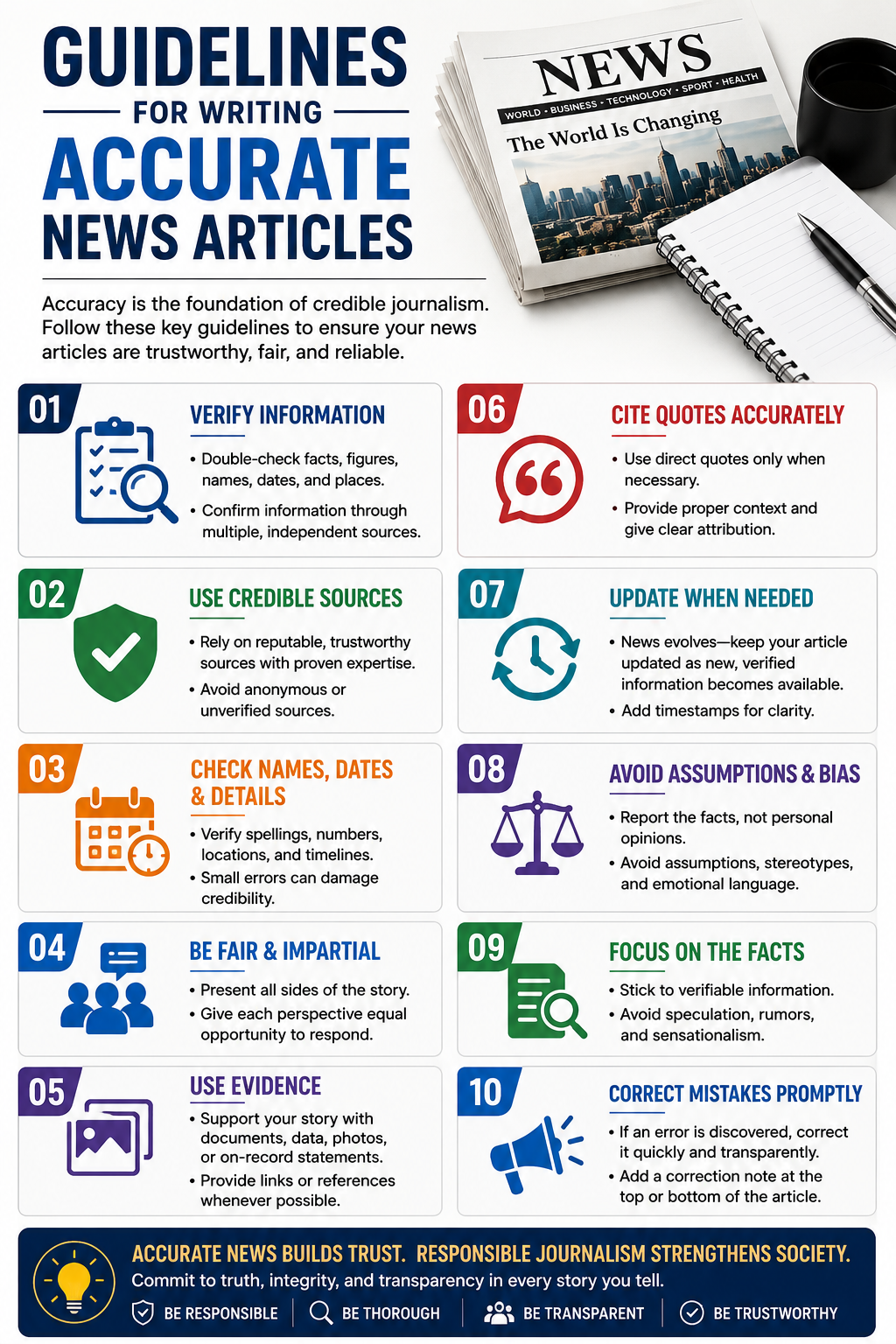
Guidelines for Writing Accurate News Articles

Guidelines for Writing Accurate News Articles Summary: This article outlines best practices for producing neutral, fact‑based news stories, covering structure, verification, and SEO considerations. Main Story Professional journalism requires a clear, organized approach that separates verified facts from analysis. Reporters should: Use a neutral tone and avoid sensational language. Clearly label opinions, editorial commentary, or speculation. Attribute every claim to a reliable source (e.g., official statements, reputable agencies). State when information is unverified or still developing. Background Traditional news writing follows a hierarchy of information, often called the “inverted pyramid.” The most critical details appear first, followed by supporting context. This format ensures readers receive essential facts quickly, even if they skim the article. Impact Adhering to these standards builds public trust and protects outlets from legal challenges. Accurate reporting also: Reduces the spread of misinformation. Supports informed civic engagement. Strengthens the credibility of journalists and their organizations. What’s Next Newsrooms are increasingly integrating digital tools for fact‑checking and source verification. Ongoing training in data literacy and bias awareness will be essential as media ecosystems evolve. SEO Recommendations For optimal search visibility, consider the following: Primary keyword: news article writing guidelines Meta description (150‑160 characters): "Learn essential, unbiased guidelines for writing accurate news articles, from structure and verification to SEO best practices." URL slug: news-article-writing-guidelines Use descriptive H2 headings and avoid keyword stuffing.

Key Guidelines for Crafting Accurate News Articles
News
Jul 25, 2026 ⏱ 2 min

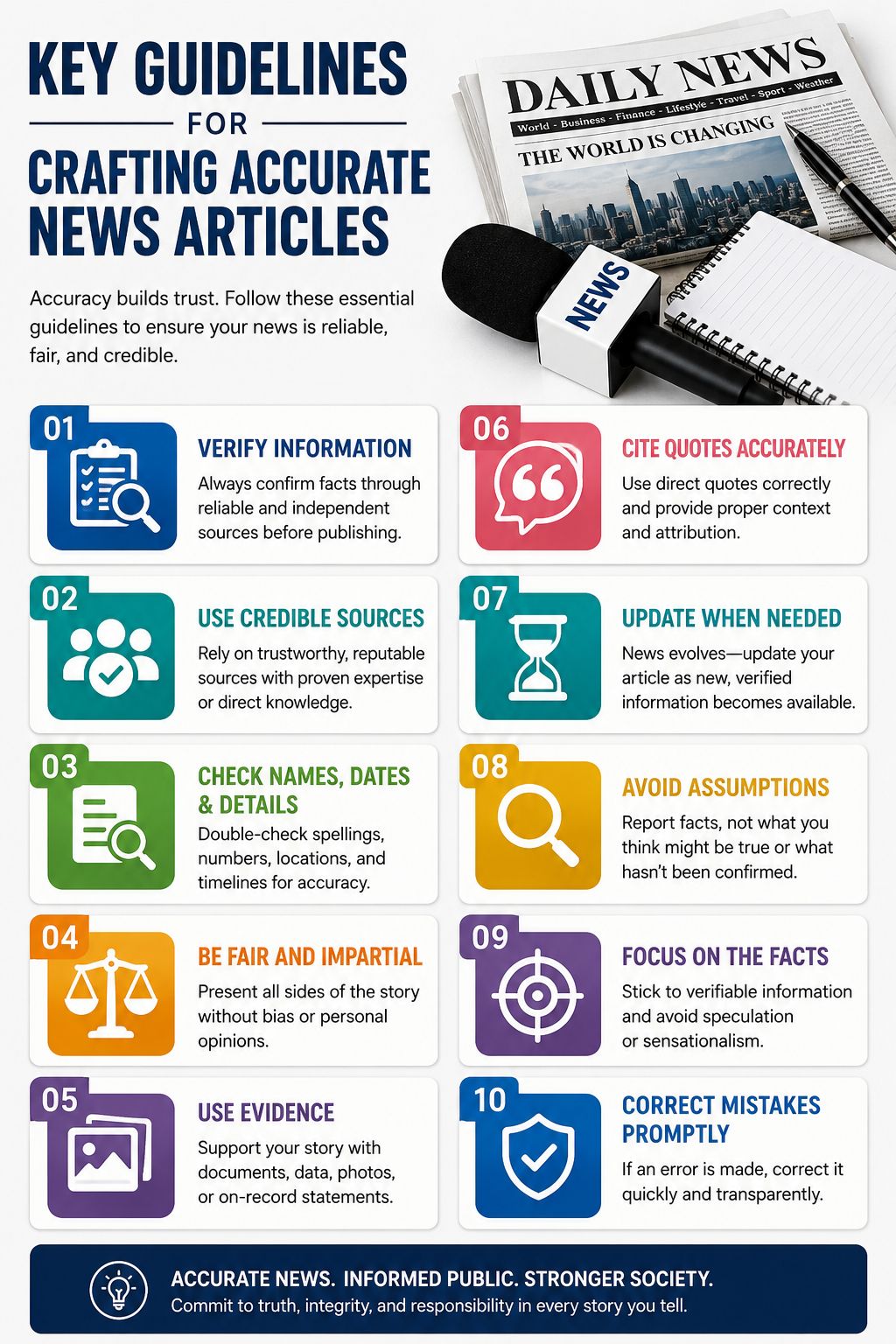
Key Guidelines for Crafting Accurate News Articles

Summary Professional news writing demands factual accuracy, neutral tone, and clear distinction between verified information and analysis. This article outlines essential practices for journalists and editors. Main Story Effective news reporting rests on three pillars: Verification: All facts, quotes, and statistics must be corroborated by reliable sources before publication. Neutrality: Use a professional, unbiased tone; avoid sensationalism and inflammatory language. Transparency: Clearly label opinions, analysis, and unverified information. Background Traditional journalistic standards have evolved with digital media, but core ethics remain unchanged. Trusted outlets continue to rely on: Multiple independent sources for key claims. Attribution of information to identifiable entities (e.g., agencies, experts, official statements). Rigorous fact‑checking workflows before stories go live. Impact Adhering to these guidelines builds audience trust, reduces the spread of misinformation, and upholds the credibility of news organizations. When journalists consistently apply these practices, they: Enhance public understanding of complex issues. Support democratic processes by providing reliable information. Mitigate legal risks associated with libel or false reporting. What's Next Newsrooms are increasingly integrating AI‑assisted tools for preliminary fact‑checking, yet human editorial judgment remains essential. Ongoing training programs and updated style guides will help journalists adapt to evolving media landscapes while preserving core standards.

The Future of Web Development: How AI is Redefining the Digital Landscape
News
Jul 25, 2026 ⏱ 3 min

The Future of Web Development: How AI is Redefining the Digital Landscape

Introduction Web development is undergoing a seismic shift, driven by rapid advances in artificial intelligence (AI). From code generation to predictive design, AI tools are empowering developers to build faster, smarter, and more personalized web experiences. Why AI Matters in Modern Web Development Integrating AI into the development workflow offers three core benefits: Speed: Automated code suggestions and bug detection reduce development cycles. Quality: Machine‑learning models spot performance bottlenecks before they reach production. Personalization: AI‑driven analytics enable dynamic UI/UX tailored to individual users. 1. AI‑Powered Code Assistants Tools like GitHub Copilot, Tabnine, and CodeWhisperer analyze millions of code snippets to suggest completions in real time. Developers can focus on architecture and logic, while the AI handles repetitive syntax. 2. Intelligent Testing & Debugging Automated testing frameworks now incorporate AI to prioritize test cases, predict flaky tests, and even generate unit tests from natural language descriptions. 3. Design Automation Platforms such as Figma’s AI plugins transform sketches into high‑fidelity prototypes, ensuring design consistency across devices. Key AI Technologies Shaping Web Development Below are the AI technologies you should watch: Large Language Models (LLMs): Power code generation, documentation, and chat‑based support. Computer Vision: Enables image optimization, automatic alt‑text generation, and AR experiences. Reinforcement Learning: Optimizes server‑side performance by learning the best resource allocation strategies. Natural Language Processing (NLP): Drives conversational interfaces, search relevance, and content personalization. Practical Steps to Integrate AI Into Your Workflow Getting started is easier than you think. Follow this roadmap: Choose the right AI assistant: Start with a free tier of Copilot or Tabnine to evaluate fit. Automate repetitive tasks: Use AI for code linting, style enforcement, and boilerplate generation. Implement AI‑enhanced testing: Integrate tools like Testim or Mabl for AI‑driven test maintenance. Leverage AI in CI/CD: Adopt predictive analytics to forecast build failures before they happen. Monitor performance: Use AI‑based observability platforms (e.g., Datadog AI, New Relic) to detect anomalies. Future Outlook: Low‑Code, No‑Code, and Beyond The convergence of AI with low‑code/no‑code platforms promises a new era where non‑technical stakeholders can contribute directly to web projects. Expect to see: AI‑generated UI components from plain English descriptions. Self‑healing applications that auto‑patch security vulnerabilities. Dynamic content personalization driven by real‑time user intent analysis. Conclusion AI is not just a buzzword—it’s a catalyst that is reshaping every layer of web development. By embracing AI tools today, developers can stay ahead of the curve, deliver higher‑quality products, and unlock innovative experiences that were once unimaginable. Ready to future‑proof your web projects? Start experimenting with AI assistants, automate your testing pipeline, and watch your productivity soar.

The Future of Web Development: AI-Powered Tools Transforming the Digital Landscape
News
Jul 25, 2026 ⏱ 2 min

The Future of Web Development: AI-Powered Tools Transforming the Digital Landscape

Introduction Web development is evolving at breakneck speed, and artificial intelligence (AI) is at the heart of this transformation. From code generation to intelligent debugging, AI-driven tools are reshaping how developers build, test, and deploy websites. Why AI Matters in Web Development Integrating AI into the development workflow brings several key advantages: Speed: Automated code suggestions cut development time by up to 40%. Quality: AI-driven testing identifies bugs before they reach production. Personalization: Machine‑learning models tailor user experiences in real time. Scalability: Intelligent resource allocation keeps apps performant under heavy load. Top AI-Powered Tools Shaping the Industry Here are some of the most impactful AI tools developers should be aware of: GitHub Copilot: An AI pair programmer that suggests entire lines or functions as you type. ChatGPT for Code: Generates snippets, explains concepts, and helps debug complex issues. DeepCode (Snyk): Scans repositories for security vulnerabilities using AI analysis. TensorFlow.js: Brings on‑device machine learning to web applications. Real‑World Applications Businesses are already leveraging AI to deliver smarter web experiences. For example, e‑commerce platforms use recommendation engines that analyze user behavior in milliseconds, while content management systems employ AI to auto‑generate SEO‑friendly meta tags. Best Practices for Integrating AI into Your Projects To maximize benefits while minimizing risk, follow these guidelines: Start Small: Pilot AI features on non‑critical components before a full rollout. Maintain Human Oversight: Use AI as an assistant, not a replacement, for critical decision‑making. Prioritize Data Privacy: Ensure compliance with GDPR, CCPA, and other regulations when handling user data. Continuously Train Models: Regularly update AI models with fresh data to keep them accurate. Conclusion AI is no longer a futuristic concept; it's a present‑day catalyst that empowers web developers to create faster, safer, and more personalized digital experiences. Embrace these AI tools today, and stay ahead in the rapidly evolving tech landscape.

European Union Fines Google Over $1 Billion for Digital Regulation Violations
News
Jul 25, 2026 ⏱ 3 min

European Union Fines Google Over $1 Billion for Digital Regulation Violations

EU Takes Strong Action Against Google Over Digital Market RulesThe European Union has imposed a fine of approximately €890 million (around $1 billion) on Google for violations related to the bloc’s Digital Markets Act (DMA). The European Commission stated that Google failed to comply with digital competition rules by favoring its own services and limiting choices for businesses and consumers. (digital-strategy.ec.europa.eu)The decision represents another major step in the EU’s effort to regulate large technology companies and create a fairer digital marketplace.Why Did the EU Fine Google?According to the European Commission, Google violated two main areas of digital regulation:1. Favoring Google’s Own Services in Search ResultsThe EU found that Google gave preferential treatment to its own services, including areas such as:ShoppingHotelsTravel servicesOther specialized search featuresRegulators argued that Google’s own products received better visibility compared with competing services. (digital-strategy.ec.europa.eu)The EU’s goal is to ensure that online platforms treat competitors fairly and do not use their dominant position to reduce competition.2. Restrictions on App DevelopersThe second issue involved Google Play and what regulators call anti-steering practices.The EU said Google restricted app developers from:Informing users about alternative purchasing optionsDirecting customers to external offersUsing other distribution channelsThe European Commission stated that businesses should have more freedom to communicate with customers and offer alternatives outside Google’s ecosystem. (digital-strategy.ec.europa.eu)How Much Is the Fine?The total penalty was divided into two parts:€460 million related to search practices€430 million related to Google Play restrictionsTogether, the fines equal approximately €890 million, exceeding one billion dollars depending on exchange rates. (Représentation en France)What Is the Digital Markets Act?The Digital Markets Act (DMA) is a European regulation designed to control the power of large digital platforms.The law focuses on companies considered "gatekeepers" that provide essential online services.Its goals include:More competitionGreater consumer choiceFairer conditions for businessesMore transparency from technology companiesGoogle’s ResponseGoogle has criticized some EU digital regulations, arguing that changes required by regulators could affect product quality and user experience.The company has previously said that regulatory changes may create challenges for innovation and competition. (The Verge)Impact on ConsumersThe EU believes stronger digital rules can benefit users by creating:More ChoicesConsumers may have access to more competing services and alternatives.Better PricesMore competition can encourage companies to offer better deals.More TransparencyUsers may receive clearer information about available options.Impact on Technology CompaniesThe decision sends a message to major technology platforms worldwide.Large companies may need to:Change business practicesProvide more access to competitorsReview platform policiesImprove transparencyOther technology companies operating in Europe may also face increased regulatory attention.Why Digital Regulation Is Becoming ImportantTechnology companies have become central to modern life through:Search enginesMobile applicationsOnline advertisingCloud servicesDigital marketplacesGovernments argue that strong regulations are needed to prevent unfair competition and protect consumers.The Future of Big Tech RegulationThe Google case highlights a broader global trend:Governments are increasing oversight of technology companies.Digital competition rules are becoming stricter.Companies must balance innovation with regulatory requirements.The relationship between technology companies and regulators will likely continue evolving as digital services become more important.ConclusionThe European Union’s billion-dollar fine against Google represents a significant moment in digital regulation. The decision shows the EU’s commitment to enforcing competition rules and limiting unfair advantages in online markets.As technology continues to expand, companies will need to adapt to new regulations while continuing to innovate and provide value to users worldwide. (digital-strategy.ec.europa.eu)

forum
smart_toy Lmaix Assistant
Hello! 👋 Welcome to Lmaix Articles. How can I help you explore today?