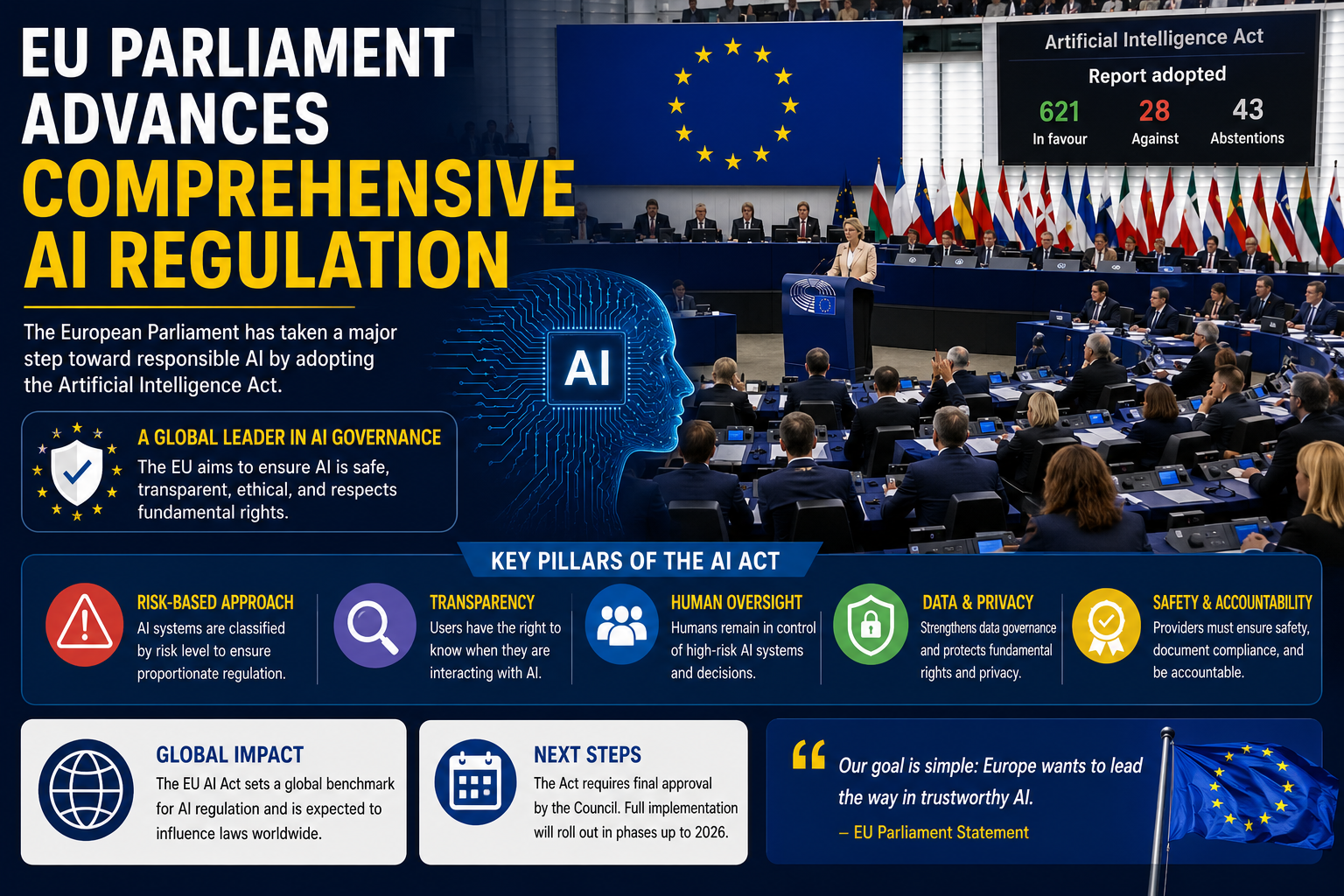
EU Parliament Advances Comprehensive AI Regulation
Summary
The European Parliament voted to accelerate the adoption of the AI Act, aiming to set the world’s first unified rules for artificial intelligence systems. The legislation targets high‑risk AI applications while preserving innovation.
Main Story
On July 24, 2026, the European Parliament’s Committee on the Internal Market and Consumer Protection approved a revised draft of the AI Act with a majority of 470 votes in favor, 150 against, and 30 abstentions. The vote moves the proposal to a plenary session scheduled for early August, where final adoption will be decided.
Key provisions in the revised draft include:
- Risk‑based classification: AI systems will be categorized into unacceptable, high, limited, and minimal risk, with corresponding compliance obligations.
- Transparency requirements: Certain AI tools, such as deep‑fakes and chatbots, must disclose that they are machine‑generated.
- Conformity assessments: High‑risk AI providers will undergo third‑party conformity checks before market entry.
- Enforcement mechanisms: National supervisory authorities will be empowered to impose fines of up to 6 % of global turnover for non‑compliance.
The European Commission has pledged to allocate €500 million over the next five years to support compliance assistance for small‑ and medium‑sized enterprises (SMEs).
Background
The AI Act was first introduced by the European Commission in April 2021 as part of the EU’s Digital Strategy. Since then, the proposal has undergone extensive negotiations among EU institutions, industry groups, and civil‑society stakeholders. Earlier drafts faced criticism for either being too restrictive on innovation or insufficiently protective of fundamental rights.
In 2024, the European Data Protection Board released guidance on the interaction between the AI Act and the GDPR, emphasizing the need for data‑privacy safeguards in AI training datasets.
Impact
- Technology companies: Major AI developers operating in Europe will need to adjust product roadmaps to meet conformity assessment timelines.
- Consumers: Users can expect clearer labeling of AI‑generated content, reducing the risk of deception.
- SMEs: The EU‑funded assistance program aims to mitigate compliance costs for smaller firms.
- International trade: Non‑EU companies exporting AI systems to the EU will be subject to the same standards, potentially influencing global AI governance norms.
What’s Next
The plenary vote, expected in early August 2026, will determine whether the AI Act is adopted in its current form or sent back for further amendments. Following adoption, member states will have 24 months to transpose the directive into national law.
Stakeholders are advised to monitor the upcoming legislative sessions and begin preliminary compliance assessments to avoid future penalties.